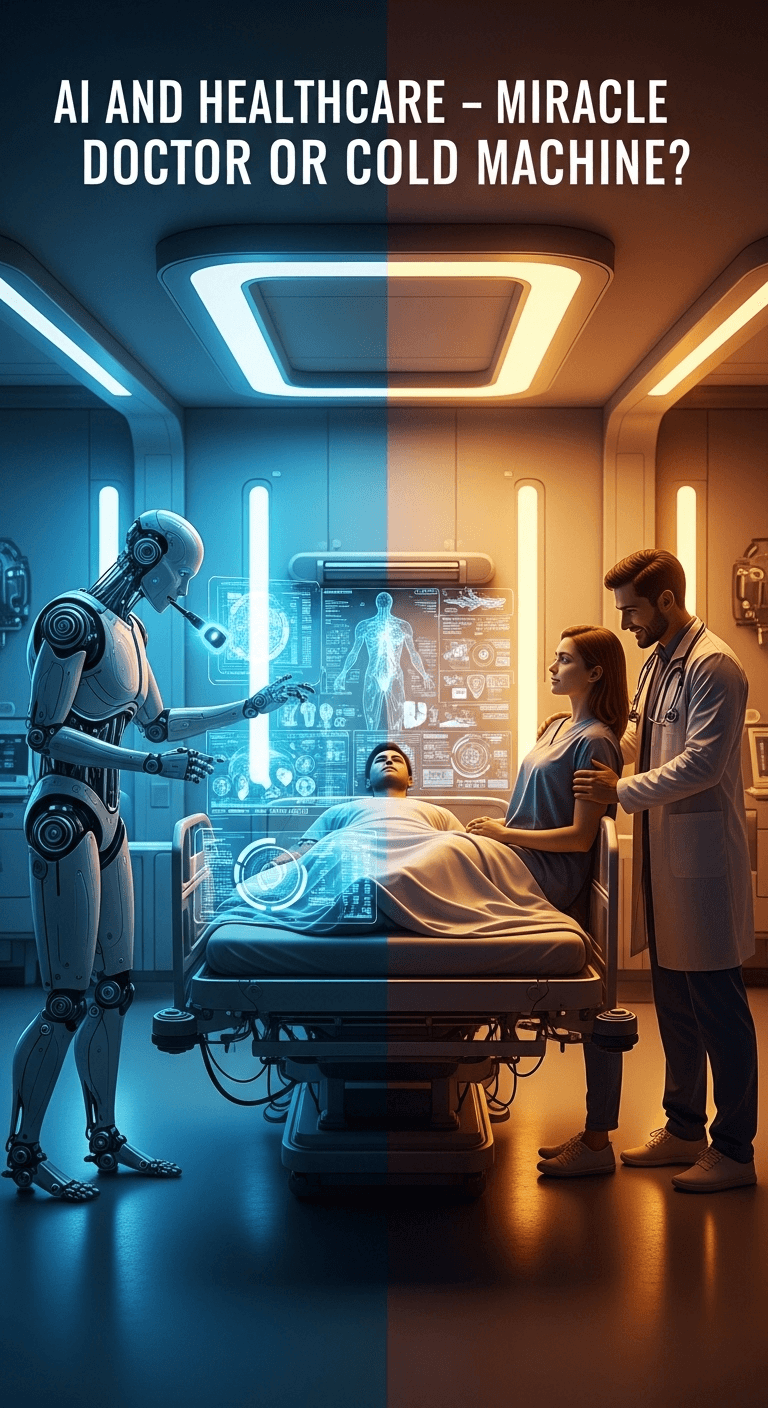
AI is transforming healthcare—from predicting diseases before symptoms show up to robotic surgeries with near-perfect precision. But can a machine really replace the warmth of a human doctor? The future of medicine may be smarter, faster, and more accurate—but it also risks becoming cold, clinical, and inhuman.
Introduction
Picture this: you walk into a hospital and instead of a doctor, an AI greets you, scans your face, and tells you exactly what’s wrong. Cool, right? But then you realize… it didn’t ask how you feel. That’s the tightrope AI is walking in healthcare: miracle doctor or cold machine?
Where AI Is Already Killing It (In a Good Way)
- Diagnostics: AI can spot cancer in scans earlier than many doctors.
- Drug discovery: What used to take years of lab work, AI can model in weeks.
- Virtual nurses: Chatbots reminding patients to take meds or track symptoms.
- Robotic surgeries: Robots assisting surgeons for steadier, safer operations.
In short—AI is becoming the superhero sidekick every doctor dreams of.
Why Patients Love It
- Faster results: No more waiting weeks for a test review.
- Personalized care: AI analyzes your data, not just averages.
- 24/7 help: A virtual assistant never gets tired.
- Cost savings: Automating admin cuts hospital bills.
For patients, it’s like healthcare finally caught up to Netflix—on-demand, personalized, and efficient.
The Cold, Creepy Side
- No empathy: A chatbot can’t hold your hand when you’re scared.
- Bias in data: If AI is trained mostly on one demographic, others suffer.
- Privacy risks: Your most personal data stored in servers—hackers salivating.
- Overreliance: What happens if doctors trust the algorithm too much?
Medicine isn’t just about fixing the body—it’s about caring for the human. That’s where AI still stumbles.
Real-Life Examples
- IBM Watson in hospitals—once hyped as the future of oncology, but stumbled when real-world complexity hit.
- Google’s AI eye scans—spotting diabetic blindness years in advance.
- Robotic-assisted surgeries—already saving lives with smaller cuts and faster recovery times.
- Mental health chatbots—like Woebot or Wysa, giving people someone to talk to at 2 AM.
The tech is already here—it’s just unevenly spread.
The Future of Healthcare With AI
- Predictive medicine: Doctors knowing your risks before you ever feel sick.
- Home hospitals: AI monitoring your health at home with wearables.
- Hybrid doctors: Humans plus AI teaming up for super-care.
- Fully AI doctors? Maybe one day—but trust will be the hardest pill to swallow.
Bottom Line
AI in healthcare is both a miracle doctor and a cold machine—depending on how we use it. The best future isn’t AI replacing doctors, but AI empowering them to be more human. Machines do the math, humans do the healing.