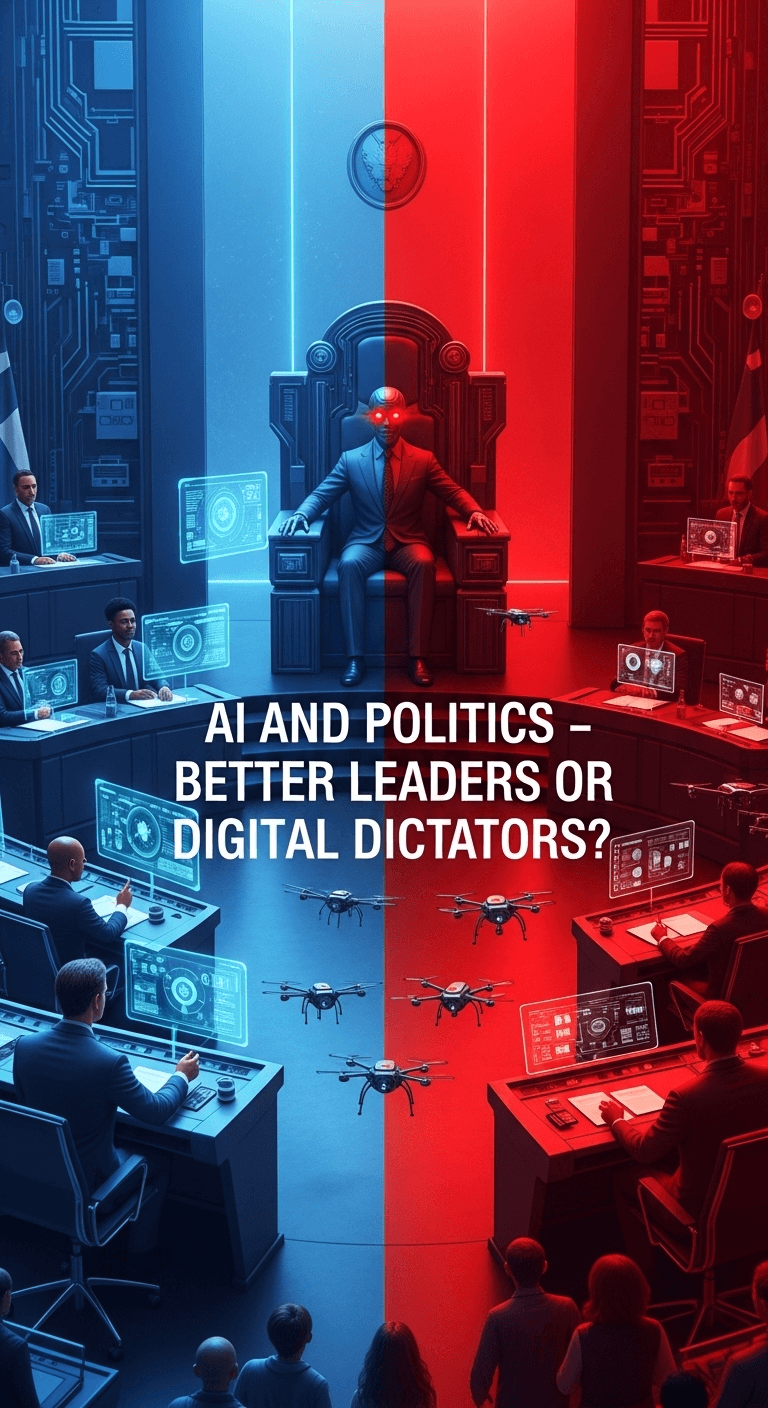
AI is creeping into politics, helping leaders make smarter decisions and citizens get their voices heard. But there’s a darker side: the same tech can be used for manipulation, surveillance, and even digital dictatorships. Will AI bring us fairer governments—or just smarter tyrants?
Introduction
Imagine an election where your candidate isn’t just a person—it’s powered by an AI that knows what every voter wants, down to their favorite snack. Sounds efficient, right? But here’s the creepy part: what if that AI also controls what news you see, how you vote, and even what you believe? Politics plus AI is a cocktail that can taste like progress—or poison.
How AI Is Already in Politics
- Campaign targeting: AI crunches voter data to show ads tailored to you.
- Speechwriting help: Algorithms draft persuasive messages.
- Poll analysis: AI predicts voter mood better than traditional surveys.
- Governance tools: Governments use AI to forecast budgets, manage cities, or track crime.
On paper, it looks like politicians finally found a brain upgrade.
Why It Sounds Like a Good Thing
- Smarter policy decisions: AI can analyze climate data, economic trends, and health risks better than humans.
- Better representation: AI might highlight what citizens truly want, not just lobbyists.
- Efficiency: Less bureaucracy, faster services.
- Transparency tools: AI fact-checkers catching lies in real-time debates.
If done right, AI could make democracy less messy and more effective.
The Dark Side Nobody Wants to Talk About
- Manipulation: AI knows what makes you tick—and what makes you vote.
- Surveillance states: Governments can track every move under the excuse of “security.”
- Deepfake chaos: Fake videos can ruin reputations overnight.
- Algorithmic bias: If the data is biased, the politics will be too.
Today’s AI could just as easily create a digital democracy—or a digital dictatorship.
Real-World Examples
- Cambridge Analytica scandal: Data-driven manipulation of voters.
- China’s surveillance AI: Tracking citizens through facial recognition.
- Deepfake videos in elections: Already confusing voters worldwide.
- Smart cities: AI-run infrastructure decisions in places like Singapore and Dubai.
We’ve already seen AI’s fingerprints on political power plays.
The Future of AI in Politics
- AI politicians? Some experiments have already tested AI chatbots “running for office.”
- Global governance AI: Systems predicting climate or pandemic crises for world leaders.
- Citizen AI tools: Apps that let people see how policies affect them instantly.
- Authoritarian AI regimes: Where leaders use tech to control populations like never before.
Bottom Line
AI in politics could make governments smarter and fairer—or manipulative and authoritarian. The real issue isn’t whether AI takes over politics, but who’s holding the remote. In the wrong hands, it’s not democracy—it’s dictatorship with better Wi-Fi.