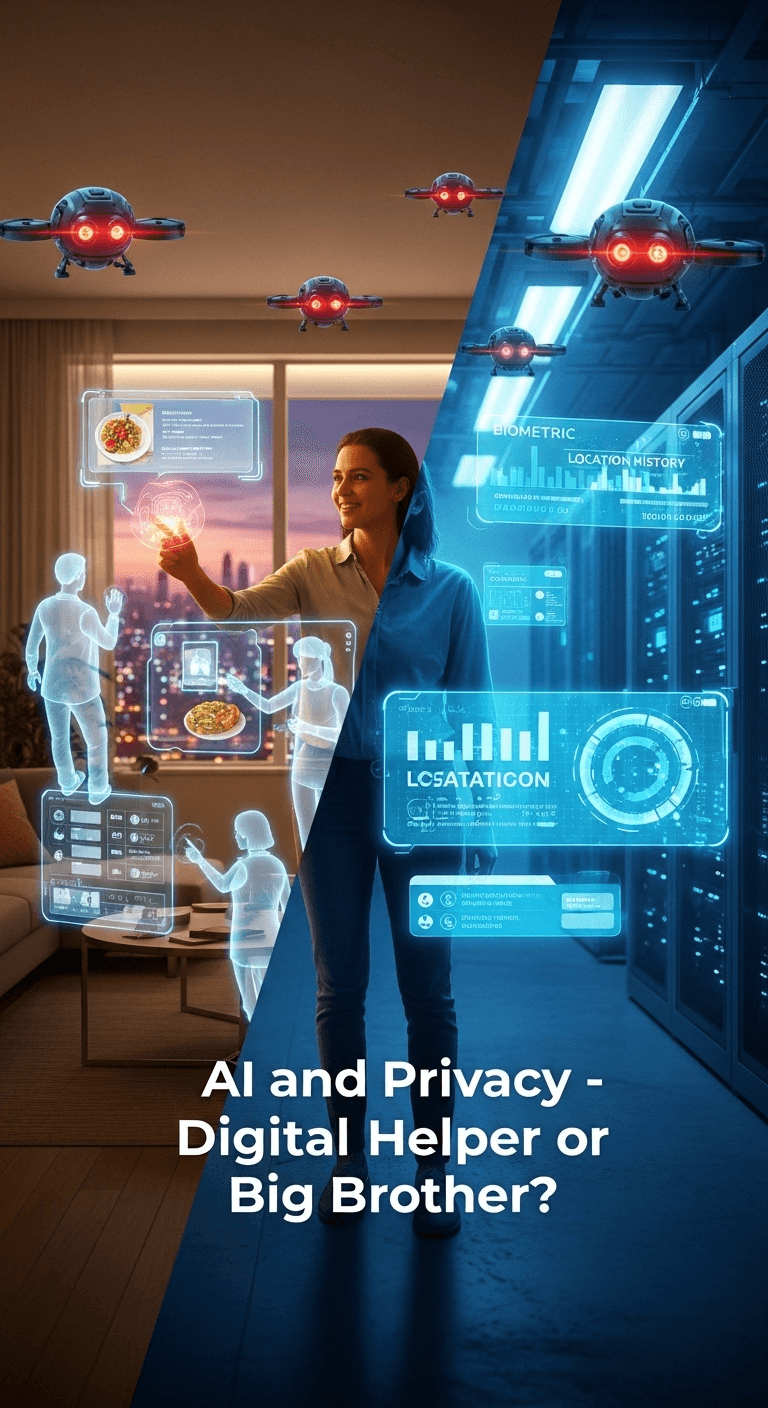
AI is everywhere—tracking habits, predicting behavior, and personalizing experiences. But while some call it a digital helper, others warn it’s the ultimate Big Brother. Can AI protect us and make life easier, or is it quietly eroding our privacy?
Introduction
Remember when privacy meant closing the curtains and locking your diary? Now, AI is analyzing every click, every purchase, and even predicting what you’ll do next. Convenient for personalized experiences—but also kinda creepy. The line between helpful and intrusive is blurrier than ever.
How AI Is Already Affecting Privacy
- Behavior tracking: AI monitors online habits to suggest products or content.
- Facial recognition: Unlocking phones, tagging photos, or identifying people in public spaces.
- Data-driven personalization: Ads, recommendations, and experiences tailored to you.
- Predictive analytics: AI predicting what you’ll like, buy, or even say next.
It’s like having a digital assistant who knows you better than you know yourself.
Why People Embrace AI Privacy Tools
- Convenience: Personalized experiences and recommendations.
- Efficiency: Less time searching, more time enjoying.
- Security features: AI detecting fraud, hacks, or suspicious activity.
- Smart home integration: AI predicting needs and automating daily tasks.
AI can feel like a helpful friend… or a personal assistant who never sleeps.
The Big Brother Problem
- Constant surveillance: Your data is collected and analyzed continuously.
- Lack of control: Many users don’t know what’s tracked or shared.
- Data breaches: Even AI systems aren’t immune from hacks.
- Manipulation risk: Targeted ads and content can influence choices and opinions.
Your “smart life” can come at the cost of your private life.
Real-World Examples
- Social media AI: Platforms tracking behavior to serve ads.
- Smart assistants: Alexa, Google Home listening for commands and collecting data.
- Facial recognition in public: AI monitoring crowds for security.
- Retail analytics: AI predicting customer habits in stores.
AI can make life smoother—but privacy isn’t guaranteed.
The Future of AI and Privacy
- Regulated AI systems: Laws and rules to protect personal data.
- Privacy-focused AI tools: Apps that anonymize or limit tracking.
- Predictive ethics: AI learning to respect boundaries.
- Global standards: International policies for secure, transparent AI usage.
The goal is AI that helps without turning life into a constant surveillance state.
Bottom Line
AI in privacy is a tightrope: it can make life convenient, secure, and personalized, but it can also creep into every corner of your life. The trick? Use AI tools wisely, stay informed, and never forget that your data is yours—not the algorithm’s.