Space—the final frontier. Humans have always dreamed of touching the stars, exploring distant planets, and maybe bumping into alien civilizations. But now, AI is stepping into the cockpit, and the results are… fascinating, ambitious, and occasionally amusing.
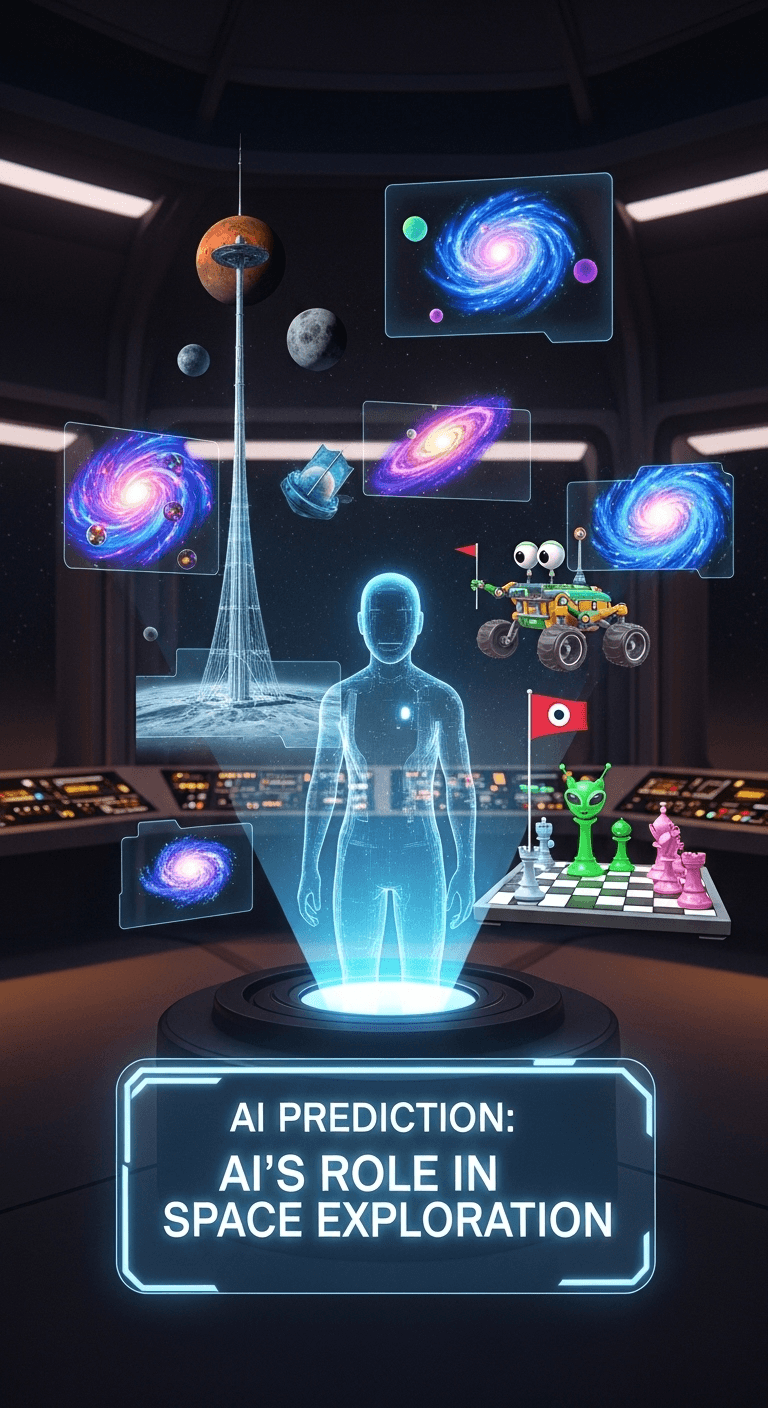
Imagine an AI tasked with predicting humanity’s next space mission. It doesn’t just crunch rocket trajectories—it starts dreaming in futuristic scenarios. In one imaginative AI simulation, it predicted: “By 2040, astronauts will commute to Mars via autonomous space elevators, guided by AI that sings them personalized space shanties.” Bold? Absolutely. Realistic? Well… not exactly. But gloriously imaginative.
Another AI forecast suggested: “Rovers on Jupiter’s moons will play chess with alien life forms, under AI supervision to ensure interplanetary peace.” Okay, maybe chess with aliens isn’t top of NASA’s priority list, but the idea is so delightfully absurd that it sparks curiosity and conversation.
These “predictions” highlight the best part of AI in space exploration—it can combine mountains of data with a touch of creative exaggeration. While it might not literally foresee cosmic chess matches, AI can identify patterns humans might overlook, propose innovative solutions, and inspire new ideas for interstellar travel.
The beauty of AI predictions is that even when they venture into the absurd, they expand our imagination. By letting AI dream big, we start dreaming bigger ourselves. We may not be building Mars elevators next week, but thinking about them in a playful, AI-generated way reminds us that space exploration is as much about creativity as it is about science.
So, buckle up. The future of space may be guided by AI logic, sprinkled with whimsical imagination—and if we’re lucky, a few humorous interstellar scenarios along the way.