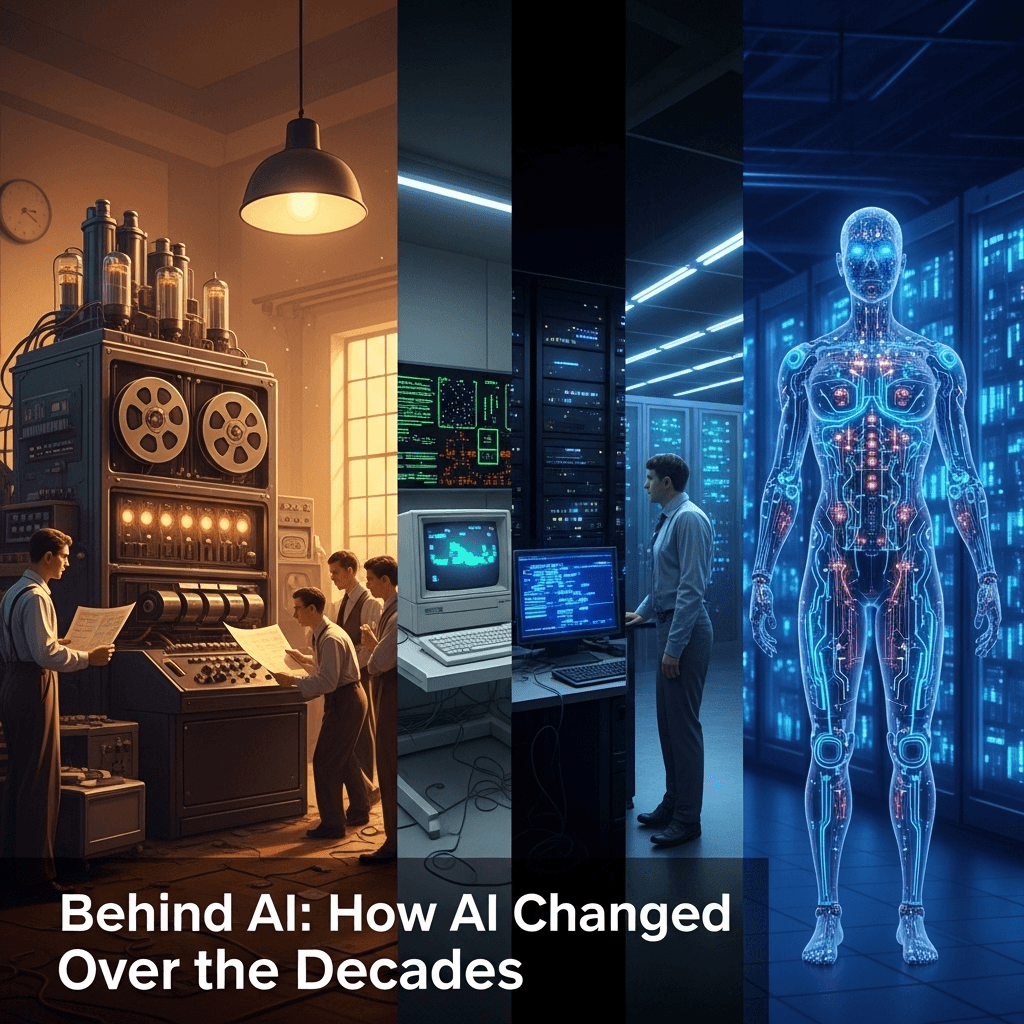
If you think AI just popped out of nowhere in the last few years, think again.
AI’s been around longer than the internet — it’s just had one heck of a glow-up.
The 1950s: The Dreamers
Back then, “artificial intelligence” sounded like science fiction whispered over coffee and cigarettes.
The first researchers — the OGs of AI — were dreamers with chalkboards, not data centers.
They thought, “Can a machine think?”
Answer: not yet, but they were sure it would, soon.
(They also thought we’d have flying cars by 1980, so… optimism was high.)
The 1980s: The Expert Systems Era
AI went corporate.
Machines could “diagnose” diseases and “recommend” business strategies — as long as you fed them enough rules.
But those systems were like that one friend who needs everything explained.
If you said, “the weather’s nice,” it would ask, “please define nice.”
Still, it was progress — the first time AI felt useful.
The 2000s: The Data Explosion
The internet arrived, and AI suddenly had snacks.
Endless data meant machines could actually learn.
We called it “machine learning,” which sounded cooler than “trial and error but really fast.”
This is when AI went from being clever code to a learning system — and it started getting… scary good.
The 2010s–Now: The Neural Revolution
Enter the deep learning era — when AI went from nerdy hobby to world celebrity.
Now it writes, paints, talks, drives, and sometimes hallucinates cats into clouds.
We’ve built models that can mimic human creativity, predict disease, even generate movie scripts.
It’s powerful. It’s messy. It’s changing everything.
And the wild part? We’re still in Chapter One.
The next decade won’t be about what AI can do — it’ll be about how we live with it.
AI used to dream of thinking like us.
Now, we’re the ones trying to understand how it thinks.