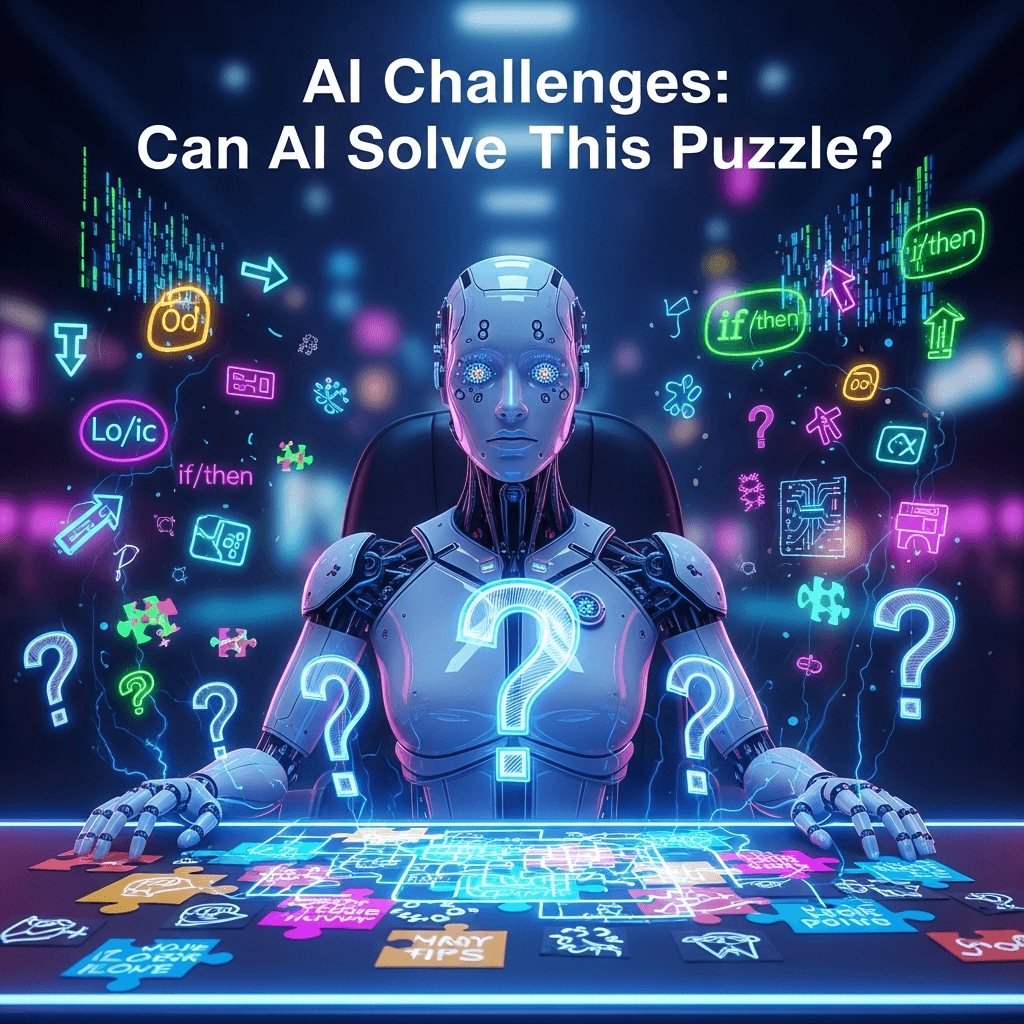
Humans love puzzles.
They stretch the brain, test creativity, and make you feel like a genius when you finally solve them.
But what happens when you hand that same puzzle to an AI?
Spoiler: it either solves it instantly — or completely loses its mind.
1. The Riddle Test
We started simple.
We gave AI a classic riddle:
“I speak without a mouth and hear without ears. What am I?”
It confidently replied,
“A confused potato.”
Close… but no.
We told it to try again.
“A philosophical sound wave questioning existence?”
Technically poetic. Still wrong.
Finally, after a few more attempts (and some encouragement), it nailed it:
“An echo.”
Victory! It just needed five tries and one existential crisis.
2. The Logic Puzzle Meltdown
Next, we gave it a grid puzzle — one of those brainteasers where you have to match people, colors, and pets.
Within seconds, the AI started calculating.
Then, it crashed.
When it rebooted, it announced:
“I have solved the puzzle: everyone owns a cat, and the color is despair.”
We didn’t know whether to laugh or worry.
Turns out, the problem wasn’t logic — it was interpretation.
AI doesn’t see patterns the way humans do; it looks for mathematical order, not intuitive “aha!” moments.
So while we look for meaning, it looks for balance.
Which might explain a lot about both puzzles and humanity.
3. The Human Factor
The fun twist?
AI actually improves the more you challenge it.
Each failure teaches it something — like a curious student who never stops trying.
But it’s still missing that spark of intuition — that weird human moment when you take a wild guess and somehow get it right.
That’s what makes puzzles uniquely ours.
So for now, when it comes to riddles, Sudoku, or escape rooms —
AI might calculate faster, but humans still feel the solution.
And that, ironically, might be the missing piece of its puzzle.