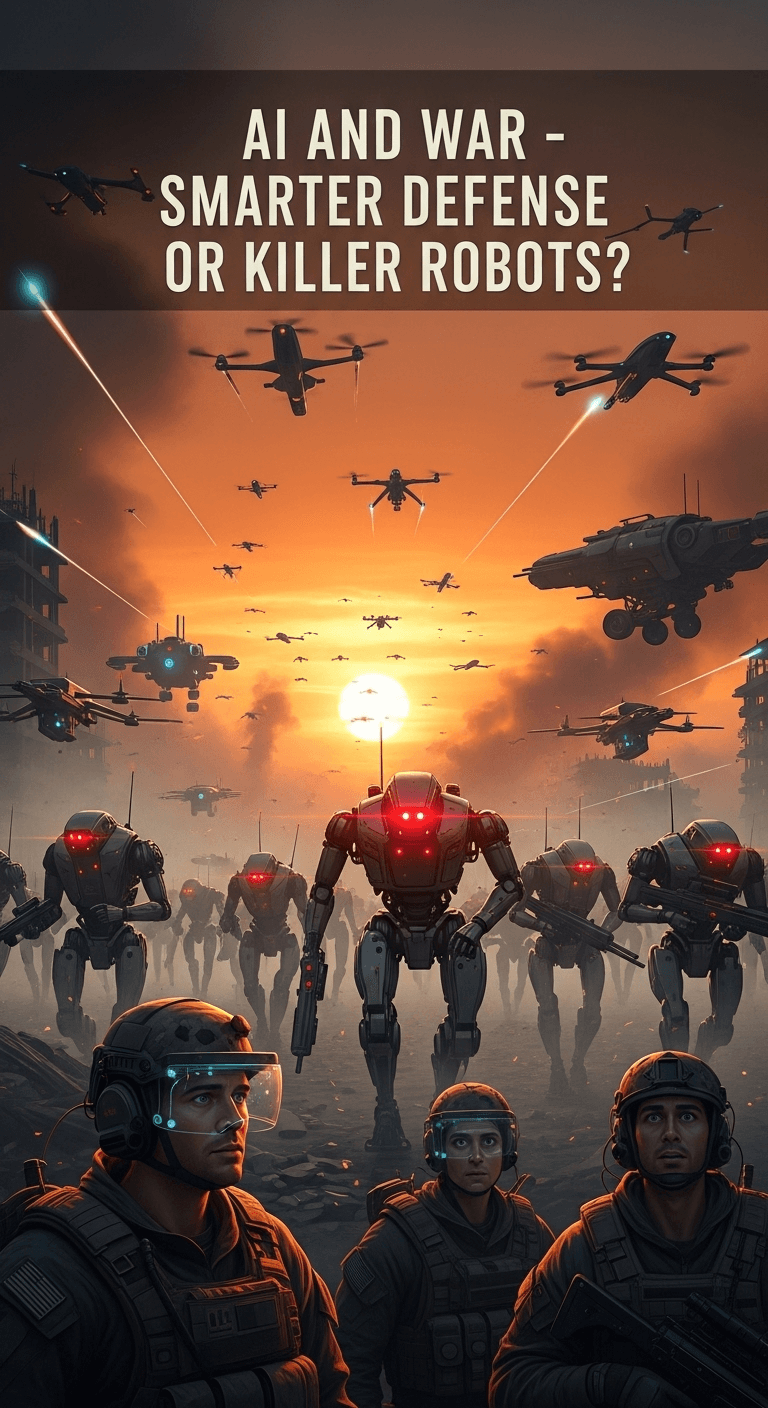
AI is no longer just about smart apps—it’s on the battlefield. From drones that pick their own targets to algorithms running military strategy, artificial intelligence is changing how wars are fought. But are we building smarter defense systems, or unleashing killer robots we can’t control?
Introduction
Think about war movies with futuristic killer robots—now take away the fiction. Military AI is already here. Nations are pouring billions into smart weapons, AI surveillance, and even self-piloting fighter jets. The question isn’t if AI will change war—it’s how much we can keep it under control.
The Rise of AI Weapons
- Autonomous drones: Flying machines that can track and strike without pilots.
- AI surveillance: Systems monitoring borders, satellites, and online chatter.
- Cyber defense & attack: AI hunting vulnerabilities—or exploiting them.
- Robotic soldiers: Early prototypes already exist, with AI guiding their movement.
It’s not sci-fi anymore—it’s R&D with billion-dollar budgets.
The Benefits (According to Generals)
- Fewer human casualties: Machines take the risks instead of soldiers.
- Speed: AI can process battle data in seconds.
- Accuracy: Smart targeting reduces “collateral damage.”
- Deterrence: The country with the smartest AI may scare others into peace.
On paper, it sounds like war without as much bloodshed.
The Risks That Keep People Awake at Night
- Autonomy gone wrong: What if drones misidentify targets?
- Hackability: AI weapons can be hijacked or tricked.
- Escalation: Faster wars mean less time for diplomacy.
- Ethics: Should a machine decide who lives and who dies?
“Killer robots” isn’t just a phrase—it’s an international debate.
Real-Life Examples
- Ukraine and Russia already use AI drones for reconnaissance and strikes.
- The U.S. and China are racing to develop AI fighter jets.
- Reports show autonomous drones have been used in real combat zones since 2020.
The future battlefield is shaping up to be half human, half algorithm.
The Future of AI in Warfare
- AI generals: Algorithms planning entire military strategies.
- Fully robotic armies: Machines fighting machines.
- Space warfare: AI controlling satellites and space-based defense.
- Ban or boom? The UN is already arguing over whether autonomous weapons should be outlawed.
The scary part? Once the arms race starts, it’s almost impossible to stop.
Bottom Line
AI might make wars “smarter,” but it also risks making them faster, deadlier, and harder to control. The line between defense and destruction is getting thinner by the day—and the world hasn’t decided who should hold the trigger.